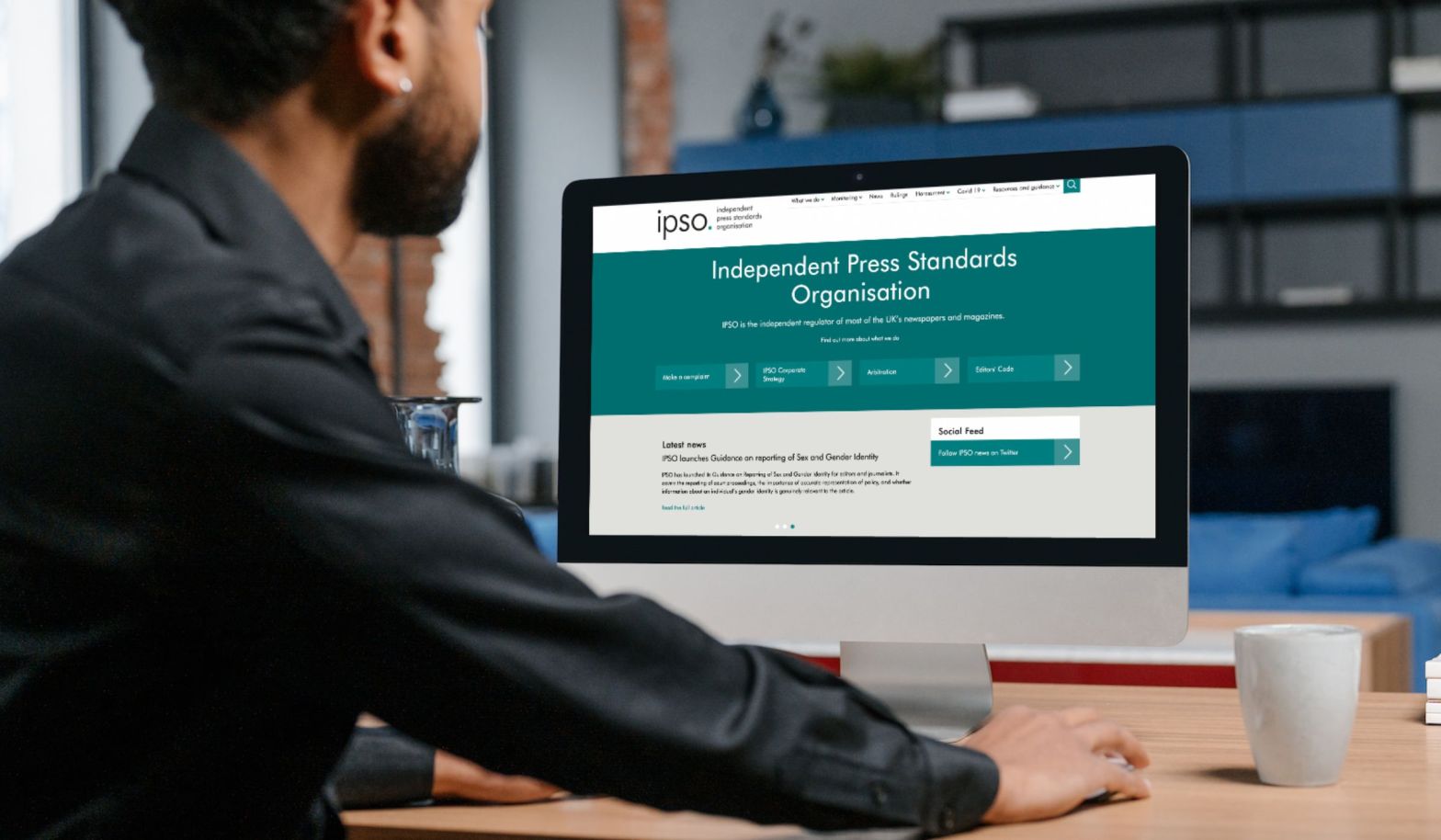
The Independent Press Standards Organisation (IPSO) has released new guidance on reporting on sex and gender, to mixed reaction from trans journalists.
The new guidance follows a four-week consultation period earlier in the year, which led to responses from the LGBTQ+ people, members of the public, charity workers and civil servants, and aims to take into account “nuanced and widely held views across society”.
The regulator said some respondents had noted the press coverage of the trans community was “disproportionate to the number of transgender individuals living in the UK” and believed misgendering happens all too often.
These respondents felt journalists and editors should use someone’s current name and pronouns when writing about that person, to ensure they do not misgender that person in coverage, and if unsure they should ask the person in question how they would like to be identified.
However, other respondents – who perhaps hold so-called gender critical views – said sex and gender identity were “two separate and distinct concepts” with their opinion being that birth sex is binary and immutable
Since its release, the new guidance has been met with cautious reaction from LGBTQ+ media professionals, particularly trans journalists, for the ambiguity it leaves in a number of areas – including misgendering, discrimination and outing.
Broadcaster India Willoughby, who is Britain’s first trans national television newsreader and co-host of an all-women talk show, expressed concern that certain sections of the mainstream press in the UK will simply “ignore the bits they don’t like – but cite the bits they do”.
She told the LGBTQ+ Journalism Network: “My worry is that before this guidance and the era of trans hysteria, print media was still happy to follow advice provided by Stonewall, Press For Change and other LGBT+ groups on the right language to use when covering trans people.
“Now however – due to the papers’ very own manufactured ‘culture wars’ – Stonewall [and so on] are viewed as either the enemy or biassed political organisations. Which they’re honestly not.”
Willoughby went on to note the ambiguity under the guidance when it comes to misgendering, whereby IPSO implies it is not correct to misgender someone directly but suggests it could be permissible for publications to mention deadnames and past pronouns in the interests of “accuracy” .
This could potentially “defeat the objective of not misgendering – and would probably lead to greater mockery,” she said.
“At face value, most of the points look sensible – but understandably the trans community are very suspicious of British media at the moment,” she said, citing the fact hundreds of anti-trans stories are published every month, “How can they trust IPSO to interpret and apply it in good faith?”
Adding: “Ideally, it might be good to have a trans-led review group who could look at how things had panned out 12 months after the guidance.”

Amelia Hansford, news reporter at PinkNews, said it was “great” to see regulatory organisations such as IPSO taking “ethical reporting on sex and gender identity” into consideration.
She welcomed discussions on the “relevancy” of reporting a person’s gender in court cases “where a person’s gender diversity may not be relevant but is brought up regardless, oftentimes through the guise of prejudice”.
She added: “Additionally, seeing protections for young people being considered is similarly great to see. Growing up as a transgender, non-binary or gender-nonconforming young person can have its own difficulties, so respecting the safety and privacy of young gender-diverse people is paramount in ethical reporting.”
However, Hansford said she was concerned the new guidance could be used to “extend protections to prejudicial rhetoric” particularly “trans-exclusionary beliefs”.
She said: “We have seen examples of this in the past, including in relation to court orders in protections under the Equality Act, and attempts to extend these protections to ‘gender-critical’ beliefs could lead to dire implications for fair and accurate reporting.”
“I hope this guidance can be the solid foundation to ensure that sex and gender identity are accurately used in journalism and that LGBTQIA+ people are given the same respect as their cisgender, heterosexual counterparts in news copy,” she added.
Ændra Rininsland, a journalist who is a member of the Trans Journalists Association and InterMedia UK, said in her opinion the guidance “could have been a lot better, it could have been a lot worse”.
“Reading the consultation document, it seems like [IPSO] got a lot of responses from the public and less so from journalists, and consequently that leads me to feel that they probably got a lot of – of I’m speculating here – anti-trans sentiment and given that it could have gone a lot worse,” Rininsland explained.
Touching on the more negative aspects of the guidance, she points out that IPSO does not define what transphobia is – despite the fact there are a multitude of clear definitions published by various organisations on the topic. A move which she believes is because “they weren’t wanting to enforce it”.
“The group that is most affected by hatred should be allowed to define what that hatred actually is,” Rinisland said.
She also noted that elements of guidance directly clash with what the Trans Journalists Association’s own style guide advocates for when reporting on trans lives.
“When quoting somebody who uses someone’s deadname, the IPSO guidance appears to indicate the quote should be printed verbatim for accuracy, whereas the TJA recommendation is that deadnames should always be replaced with the person’s chosen name in square brackets,” she explained.
Noting the more fair points made by the guidance, Rininsland said some of it “strikes a decent balance”, such as the fact that opinion pieces should pass an accuracy test, reporting on gender diverse defendants and the guidance related to Clause 12 (Discrimination).
However, she added, “much else though was rather unclear”.

jane fae, of Trans Media Watch, told the LGBTQ+ Journalism Network that on the “surface” the new guidance is positive and is a “step forward”, such as in the area of misgendering, but questioned if it does “what we need it to do in terms of minorities”.
fae specifically noted issues with freedom of expression under IPSO guidance, whereby someone cannot make inaccurate comments – which have the potential to be legally libelous – about an individual person, but they can do so about wider groups such as the trans community or Black people without redress.
This is often something which is done by the mainstream press in regards to ‘Trans Rights Activists’, where the press make disparaging claims but because it is a population-wide group of people united with certain similar characteristics – rather than an official organisation – there is no right of reply.
“The guidance continues the issue we have had with IPSO pretty much since day one, and since before it was IPSO,” she added.
Further to this, fae made reference to a viral story – which ran like wildfire through the mainstream press – that a pupil at a secondary school in East Sussex was identifying as a cat.
Fae questioned the accuracy of the story and if there was even a specific child in the first place to which the story related, noting that in the original audio recording no individual child was heard saying they are a cat or anything similar.
She pointed out the difficulties in complaining about such an article through IPSO because fundamentally if such a child does not exist, there is no one to complain about the article; meaning the publication can push untruths unquestioned in a catch-22 situation.
Like Rininsland, fae also pointed out how unacceptable it is that IPSO does not have a working definition of transphobia, saying the lack of a definition by the regulator is “tone deaf”.
Musing if the new guidance will change anything in the UK media, fae noted that “time will tell” on the matter.
A view perhaps shared by many trans, and wider queer journalists, who will be keeping an eye on IPSO’s rulings in the coming months and years to see if it does have any impact on the press’s representations of trans people.
Releasing comments alongside the guidance, Jane Debois – head of standards and regulation at IPSO – said: “We identified that reporting of sex and gender identity regularly features in the UK press.
“Engagement with journalists, advisory groups and IPSO committees revealed the plurality of opinions held and the challenges faced when reporting on sex and gender identity.
“This non-binding guidance is intended to support journalists and editors in the reporting of sex and gender identity, understand how the Editors’ Code of Practice is applied and to raise editorial standards in this area of reporting.”
Debois added: “We received a positive response to our public consultation on the draft guidance. The responses received highlighted the interest in this area of reporting and the differing opinions held by many.
“The purpose of the guidance is to highlight challenging areas that have been raised by editors and considered by IPSO’s Complaints Committee.
“The consultation results showed that there are areas to continue to consider carefully: the reporting of transgender defendants, and the presentation of opinions.
“The final guidance, which includes some of the suggestions from the consultation, is not meant to be prescriptive or oversimplify a complex area of reporting.”
Are you a member of our online community yet? Why not like our Facebook pageand follow us on Twitter and Instagram? How about you check out our latest news and contributions to Journalist Like Me?
 LGBTQ+ Journalism Network